Keenious is a reccomendation tool that uses AI to analyze your text, and suggests scholarly papers based on an algorithm. This tool can provide a search result list that contains sources that may not appear on your database search result lists, often including a few surprises.
This tool is not meant to replace the literature search, but act as an additional way of finding sources. Research shows that Keenious should be used alongside database searches, as there is little overlap in results.
Keenious may provide keywords (topics) that you can utilize in your literature search in Oria or databases. Keenious may also act as an aid at the end of the writing. If you perform an analysis of your (almost) completed text, you can look through the suggestion list and see if you have missed anything during your search prosess.
Frequently asked questions:
By filling out this form you can have the program added to your Word program. This connection will only be made if you use your Feide-login to log on to Word. It may take 24 hours to acquire the add-on. You can also use it in your browser here, no download required.
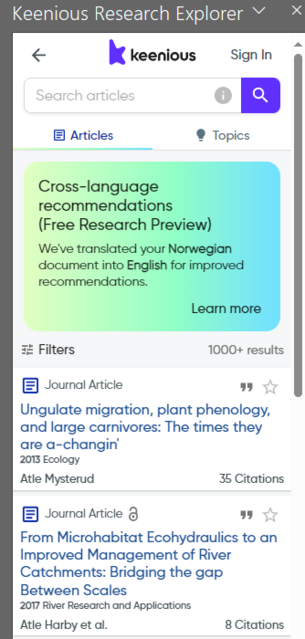
Keenious is an addition to your "literature-finding-toolkit". It utilizes your whole text to suggest articles, instead of keywords. Once you have acquired the add-on, you can open a document in Word, choose the Keenious tab in the top, and press «Explore using text». I forslagslista kan du trykke på en tittel for å lese sammendraget og se om du har tilgang til teksten i sin helhet via «Check USN Access»-knappen. Man kan også se hvilke Topics (emneord) som har blitt satt på artikkelen. For å kopiere referansen kan du trykke på hermetegnene øverst på artikkelen. For å markere den som din favoritt, kan du trykke på stjernen på toppen av artikkelen. Dette krever at du er pålogget med en Keenious-bruker. Les Keenious sine egne søketips her.
Dette verktøyet kan være nyttig dersom du er i starten av skrivingen, og vil bli kjent med et fagområde. Her kan du lese mer om de emnene (Topics) som blir foreslått, og utforske artikler som er skrevet på temaet. Dersom du er i slutten av en skriveprosess kan dette også være en nyttig ressurs. Du kan blant annet markere avsnitt som du ønsker litt mer stoff på, og se om det dukker opp noe du ikke allerede har oppdaget i dine litteratursøk.
Dette skal kun fungere som et verktøy i tillegg til søk i Oria og databaser. Det er fortsatt nødvendig å utføre søk selv, basert på ord og synonymer du finner i din problemstilling. Denne prosessen er viktig for å bli kjent med ditt fagområde, og det er her du vil finne flesteparten av dine kilder. Keenious er ment som et supplement til denne prosessen, og som et verktøy for å hjelpe deg på veien.
I trefflista kan du trykke på “Filters” for å sette avgrensning på år. I trefflista kan du også velge fanen “Topics”. Her kan du lese kort om de emneordene som beskriver artiklene i trefflista.
Dersom det er noen spesielle avsnitt du ønsker å fokusere på, kan du markere teksten. Under søkeboksen i Keenious vil det stå “Highlighting text”, og du kan da trykke på søkeknappen på nytt for å generere anbefalinger som vektlegger den markerte teksten.
Når du klikker på en artikkel, så kan du scrolle ned for å se “Similar articles”, altså artikler som ligner på den du allerede har klikket deg inn på.
https://help.keenious.com/article/35-how-to-search-with-keenious